








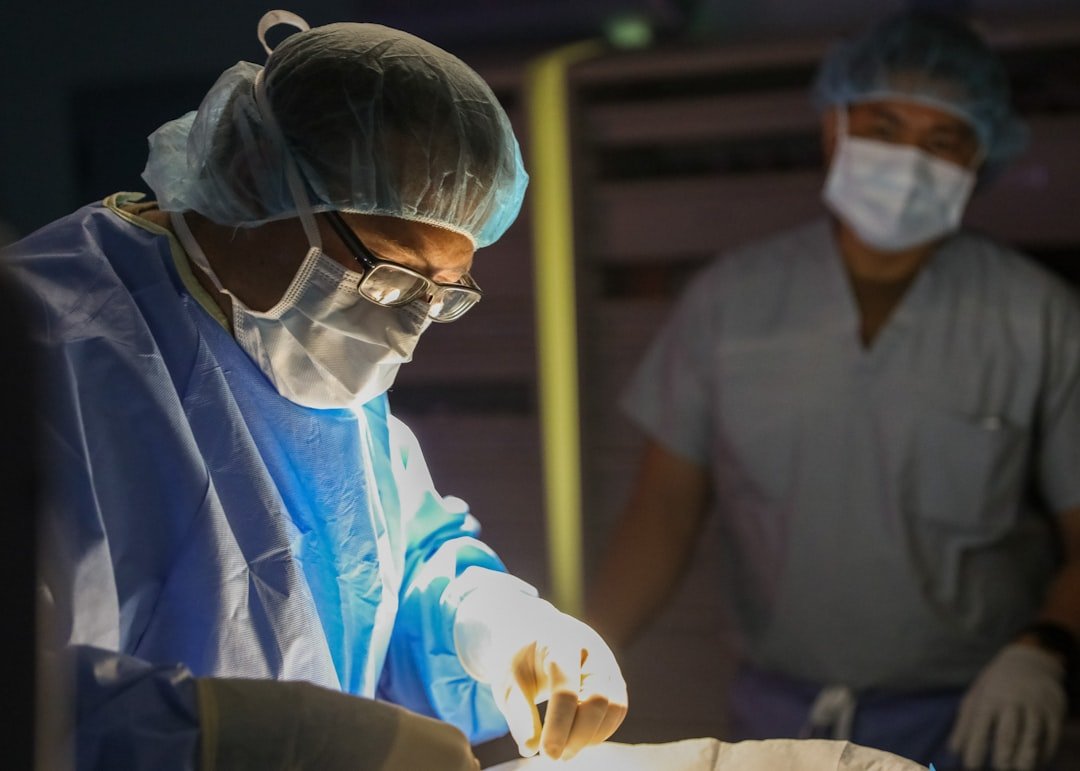
AI is getting pretty good at helping surgeons get ready for and perform operations. Think of it as having a super-smart assistant that can analyze a ton of data to show you the best way to approach a surgery and even guide the robotic tools with remarkable precision. This isn’t about replacing surgeons; it’s about giving them better tools and insights to make surgeries safer and more effective.
AI’s role in surgery isn’t a single magic bullet; it’s a suite of technologies working together. At its core, AI is about computers learning from data. In surgery, this means feeding these systems vast amounts of information from patient scans, past surgeries, and anatomical models.
Image Analysis and Segmentation
One of the first places AI steps in is by looking at medical images. When a surgeon needs to operate, they rely heavily on scans like CT or MRI. AI can zoom in on these, identifying and outlining specific structures – organs, tumors, blood vessels – with incredible speed and accuracy.
Delineating Critical Anatomy
This process, called segmentation, is crucial. AI algorithms can be trained to consistently distinguish between, say, a healthy kidney and a tumor, or to precisely map out the exact boundaries of an organ that needs to be removed. This saves surgeons valuable time during the planning phase and ensures nothing is missed.
Identifying Anomalies and Variations
Beyond just outlining normal anatomy, AI can also flag subtle anomalies or patient-specific variations that might not be immediately obvious to the human eye, especially in complex cases. This pre-operative awareness can be a significant advantage.
Predictive Modeling and Risk Assessment
AI isn’t just about seeing what’s there; it can also make educated guesses about what might happen. By analyzing data from thousands of previous surgeries, AI can help predict potential complications or how a patient might respond to a particular surgical approach.
Foreseeing Potential Complications
This predictive capability is powerful. If AI identifies patterns in a patient’s data that historically correlate with higher risks of infection, bleeding, or longer recovery times, the surgical team can be alerted. This allows for proactive planning, adjustments to the surgical strategy, or even taking extra precautions.
Estimating Procedure Likelihood of Success
AI can also offer insights into the estimated likelihood of success for different surgical pathways. This might involve comparing the current patient’s profile against large datasets of similar procedures and outcomes.
Enhancing Pre-Operative Planning
Before the first incision is made, AI is busy creating a more detailed and personalized roadmap for the operation. This goes beyond what traditional methods can offer, leading to more informed decisions and a more confident surgical team.
Creating Patient-Specific 3D Models
AI’s ability to process complex imaging data allows for the creation of highly detailed three-dimensional models of a patient’s anatomy. These aren’t just pretty pictures; they are functional tools that surgeons can manipulate and study from every angle.
Virtual Surgical Rehearsal
Surgeons can use these 3D models to “rehearse” the surgery virtually. They can practice approaching the target area, identify potential challenges, and refine their technique without any risk to the patient. This is like a flight simulator for surgeons.
Visualizing Difficult Anatomical Structures
For areas with complex anatomy, like the brain or certain parts of the abdomen, these AI-generated models provide unparalleled clarity. They can highlight nerve pathways, critical blood vessels, or challenging tumor locations that might be difficult to fully appreciate on 2D scans alone.
Optimizing Surgical Approaches
Based on the detailed models and predictive analysis, AI can suggest the most optimal surgical approach. This might involve recommending the best entry points, the most efficient sequence of steps, or alternative techniques that might be less invasive.
Determining Optimal Incision Placement
AI can analyze anatomical landmarks and the position of target structures to suggest optimal incision locations. This can minimize tissue damage, reduce scarring, and potentially lead to quicker recovery.
Planning the Order of Surgical Steps
For complex procedures, the order in which certain actions are performed can be critical. AI can analyze the relationships between different anatomical structures and the proposed surgical steps to recommend a sequence that minimizes risk and maximizes efficiency.
Guiding Robotic-Assisted Procedures
Robotic surgery has already revolutionized many procedures, offering increased precision and minimally invasive access. AI takes this a step further by providing intelligent guidance and enhancing the robot’s capabilities.
Real-time Navigation and Guidance
During the surgery itself, AI can act as a constant co-pilot for the robotic system. It can continuously track the surgical instruments and the patient’s anatomy, providing real-time feedback and guidance to the surgeon.
Overlaying Pre-operative Plans onto Live View
Imagine a surgeon looking through their robotic console and seeing their pre-operative 3D plan seamlessly overlaid onto the live video feed from the surgical site. AI makes this possible, acting like an augmented reality system for the operating room.
Warning of Proximity to Critical Structures
As the robotic instruments move, AI can constantly monitor their proximity to vital organs, nerves, or blood vessels. If an instrument gets too close to a structure flagged as critical during the planning phase, the AI can provide a visual or auditory warning.
Enhancing Instrument Control and Precision
Robotic arms are already incredibly steady, but AI can refine their movements even further, executing tasks with microscopic precision.
Micro-Movements and Tremor Reduction
AI algorithms can filter out any minute tremors from the surgeon’s hand or the environment, allowing the robotic instruments to perform movements with sub-millimeter accuracy. This is particularly valuable in delicate surgeries.
Autonomous Tasks for Repetitive Motions
In some cases, AI can even take over highly repetitive or standardized surgical tasks. For example, it could be programmed to precisely cut along a predetermined line or to suture at specific intervals, freeing up the surgeon to focus on more critical decision-making.
Improving Surgeon Performance and Training
AI’s impact isn’t limited to the immediate surgical procedure; it’s also shaping how surgeons develop their skills and how surgical teams collaborate.
Personalized Feedback and Performance Analysis
After a surgery, AI can analyze video recordings and instrument data to provide detailed feedback on the surgeon’s performance. This isn’t about judgment; it’s about identifying areas for improvement.
Identifying Patterns in Surgical Technique
AI can pinpoint specific techniques that were particularly effective or areas where there might have been slight deviations from the planned approach. This data can be used to refine individual surgical skills.
Benchmarking Against Best Practices
By comparing a surgeon’s performance against data from highly experienced surgeons performing similar procedures, AI can offer benchmarks and suggestions for improvement based on proven best practices.
Advanced Training Simulations
AI is making surgical training more realistic and effective. It can create highly dynamic and adaptive training scenarios that challenge trainees in ways that were previously impossible.
Realistic Scenario Generation
AI can generate a wide range of surgical scenarios, from common procedures to rare and complex complications. These simulations can respond dynamically to the trainee’s actions, providing a more authentic learning experience.
Objective Performance Evaluation
During simulations, AI can objectively track a trainee’s performance, providing detailed metrics on accuracy, efficiency, and decision-making. This allows for a more standardized and unbiased assessment of skill development.
The Future of AI in Surgery
| Benefits of AI in Surgical Planning and Robotic-Assisted Procedures | Metrics |
|---|---|
| Improved preoperative planning | Reduction in surgical time |
| Enhanced accuracy in identifying anatomical structures | Decrease in postoperative complications |
| Real-time feedback during robotic-assisted procedures | Increased precision in surgical tasks |
| Integration of patient-specific data for personalized treatment | Enhanced patient outcomes |
The integration of AI into surgical workflows is still evolving, but the trajectory is clear: greater integration, more autonomy in specific tasks, and deeper insights. We’re likely to see AI move from being a planning and guidance tool to an even more active participant in certain aspects of surgery.
Increased Autonomy for Specific Surgical Subtasks
As AI systems become more robust and validated, we can expect them to take on more complex and autonomous roles within defined surgical subtasks. This could include more intricate dissection, precise stapling, or automated wound closure in specific scenarios.
Enhanced Data Integration for Holistic Patient Views
Future AI systems will likely integrate even more diverse data sources – not just imaging, but also genomics, patient history, wearable device data, and real-world outcomes – to create a truly holistic view of the patient and their health.
Continuous Learning and Adaptation of AI Models
The AI systems themselves will continue to learn and adapt. As more surgeries are performed with AI assistance, the algorithms will refine their understanding, leading to even more accurate predictions and more effective guidance over time. This creates a virtuous cycle of improvement.