








When AI Agents Learn to Persuade Us: What We Must Not Surrender in the Age of AI-Enabled Influence
Author: Dr Alvin Chan
Affiliation: Global Professor of the Practice, Golden Gate University (USA)
1. Introduction
As a professor teaching applied artificial intelligence and business, I believe people should learn to use AI.
It can save time, explain difficult ideas, and support creative work.
But I am also concerned about a different question.
However, as AI becomes better at persuading people, are we making it easier for a small number of actors?
Moreover, what would this mean for what people believe?
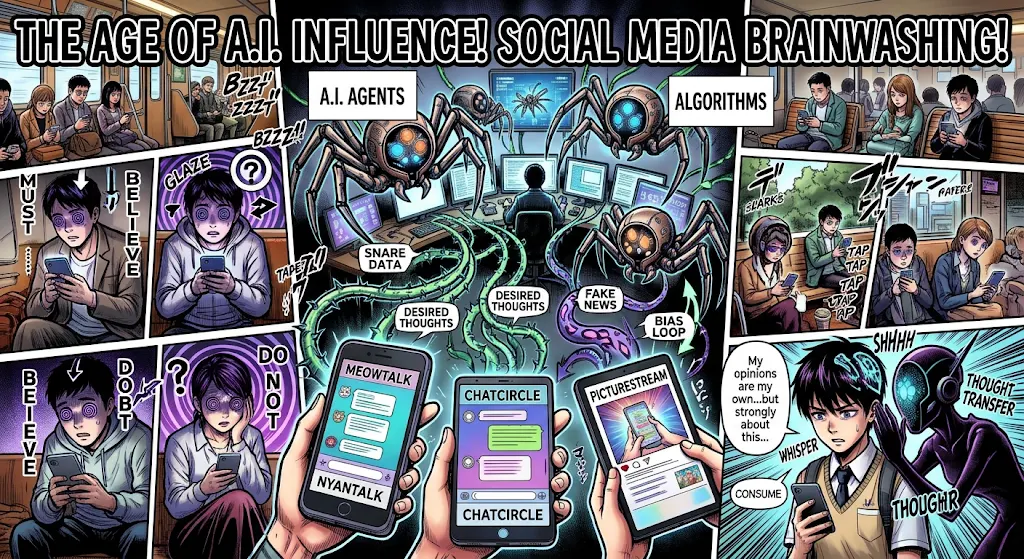
As a result, over the next few years, I expect more AI agents to appear on social media. Additionally, these AI agents may write posts, reply to comments, create images and videos, and coordinate campaigns across platforms. In particular, some will be used by businesses, public agencies and civic groups. Others may be used to create outrage. They can spread false claims or inflame a viewpoint.
The danger is not that AI will suddenly develop a desire to control people. AI does not want anything by itself. It needs a human operator, a goal, money, data, and access to platforms. The real danger is that people may use AI to influence others at a speed and scale that ordinary citizens cannot easily notice or challenge.
This is not a distant science-fiction problem. It is a problem for every society that relies on social media for news, debate, business and community life.
2. What AI Agents Can Do
Additionally, AI agents are more than chatbots that answer questions. They can be given a goal and use digital tools to achieve it. For example, they may search for information, write posts, reply to users, analyze engagement, and adjust messages.
On social media, AI agents could:
- Create persuasive posts, comments, images, audio, and short videos.
- Operate many accounts with different names, personalities, and political views.
- Reply quickly to users and keep conversations going.
- Test different messages to see which one attracts more attention.
- Coordinate posts across accounts, groups, and platforms.
- Target people according to language, interests, location, or political beliefs.
- Use hashtags, reposts, and comments to make a message appear popular.
This does not require a conscious machine. It requires a person or organization with a goal, access to AI tools and enough resources to run a campaign.
3. Why “Brainwashing” Is the Wrong Word
The word “brainwashing” suggests that people can be completely controlled by messages. That is too strong. People are not empty containers waiting to be filled by an algorithm.
People are influenced by many things: family, friends, schools, work, religion, personal experience and trust in institutions. A social-media post rarely changes someone’s mind on its own.
But influence does not need to be total to be harmful. A campaign does not need to convince everyone. It only needs to make one view seem more common, more urgent or more acceptable than it really is.
This is the real risk: not mind control, but manufactured consent. People may mistake a coordinated campaign for genuine public opinion. They may become more fearful, more divided or less willing to trust public institutions.
4. A Familiar Example: The Fake Local Protest
Imagine that a city announces a plan to build a new train line through several neighborhoods. Some residents have real concerns. They may worry about noise, construction, traffic, safety or the value of their homes. These concerns deserve a serious public debate.
Now imagine that an influence campaign creates hundreds of AI-generated accounts. Some accounts appear to be worried parents. Others appear to be small-business owners. Others appear to be local activists. They post angry videos, repeat the same claims and attack anyone who supports the project.
A real resident may see hundreds of angry comments and think: “Everyone hates this plan.” But perhaps many of those accounts were created by a property developer, a political group or a foreign actor trying to weaken trust in the government.
The problem is not that residents question public projects. They should question them. The problem is that AI can make a small, coordinated effort look like a large grassroots movement.
5. Another Example: The Manufactured Health Scare
During a disease outbreak, an AI agent could create a short video showing a supposed doctor warning that a vaccine is dangerous. The video may use a realistic synthetic voice, fake credentials and edited news clips.
The campaign may begin with a few accounts sharing the video. Other AI accounts may then add comments such as: “My cousin had the same reaction,” or “The authorities are hiding the truth.”
The system may target people who have searched for health information, joined parenting groups or expressed distrust of medical institutions. Some viewers may believe the video. Others may simply become confused.
Even if people do not fully believe the claim, repeated exposure can create doubt. They may delay medical advice, share the video with family members or lose confidence in public-health guidance.
The issue is not that people should never question vaccines or public-health advice. They should ask questions. The issue is that AI can make false claims look more credible, personal and widespread than they really are.
6. Another Example: Election Deepfakes
During an election, an AI agent could create a fake video or audio recording of a candidate saying something they never said. The clip may be released shortly before polling day, when journalists and fact-checkers have little time to respond.
The campaign may then use networks of accounts to share the clip with different groups of voters. One group may be told that the candidate is corrupt. Another may be told that the candidate is extreme. Another may be told that the candidate is incompetent.
The aim may not be to convince every voter. It may be enough to create confusion, anger and distrust. If people cannot agree on what is real, they may become less willing to accept election results or trust democratic institutions.
This is why AI-generated political content needs clear labels, quick fact-checking and strong platform safeguards.
7. Why This May Become More Common
Several trends make AI-enabled influence more likely in the near future.
First, creating content is becoming cheaper. A person can now use AI to produce text, images, audio and video quickly. This reduces the need for a large team of writers, designers and video editors.
Second, social-media platforms reward attention. Posts that create anger, fear or strong emotions often receive more views. This can encourage people to create divisive content.
Third, fake accounts are becoming harder to detect. AI can help create realistic profiles, write natural-sounding comments and imitate different types of users.
Fourth, influence campaigns can operate across borders. A campaign may be planned in one country, hosted on servers in another and targeted at people in many countries. This makes national laws alone insufficient.
Finally, people have limited time and attention. No one can check every post, trace every account or investigate every video. This makes it easier for false or misleading content to spread before it can be corrected.
8. Why Singapore Should Pay Attention
Singapore is highly connected and digitally literate. Its people use social media, messaging apps and online platforms for news, work, shopping and community life. This brings many benefits, but it also means that harmful content can spread quickly.
Singapore is also an open society. People consume news, entertainment and political commentary from many countries. This makes it difficult to isolate the country from foreign influence campaigns, scams, extremist material or commercial manipulation.
At the same time, Singapore has advantages. It has strong public institutions, established laws against online harms and public education programmes that help people recognize false or misleading content.
However, laws alone cannot solve the problem. By the time a false story has spread widely, many people may already have seen it. They may remember the claim, even after it has been corrected.
9. What Singapore Already Has
Singapore has begun to build safeguards, but AI is developing faster than regulation.
The Infocomm Media Development Authority has published a Model AI Governance Framework. It emphasizes that humans remain responsible when AI systems are used, and it encourages organizations to set clear responsibilities, monitor risks and train staff (Infocomm Media Development Authority [IMDA], 2024).
IMDA has also published transparency guidelines for generative-AI chatbots. These guidelines encourage organizations to tell users what a chatbot can and cannot do, how reliable it is, how data is handled and how problems can be reported (IMDA, 2026).
Singapore also has rules for election advertising. During an election period, digitally generated or manipulated online election advertising that falsely depicts a candidate’s speech or actions is prohibited (Singapore Elections Department, 2025).
These are useful steps. But AI agents may operate across many platforms, languages and countries. A campaign may be launched overseas, hosted on foreign servers and targeted at Singapore users through accounts that are difficult to trace.
This means Singapore cannot rely only on domestic rules. It needs cooperation with platforms, other governments, researchers, journalists and civil-society groups.
10. What We Must Protect
We should not ban AI. That would be unrealistic. AI can bring real benefits: better public services, easier access to information, improved productivity and new forms of creative work.
Instead, societies should protect three things: truth, agency and trust.
Truth
People should be able to know whether content is AI-generated or manipulated, especially when it concerns elections, public safety, health, money or government.
Platforms should clearly label synthetic content where possible. They should also make it easier for users to report suspected fake accounts, coordinated campaigns and manipulated videos.
Detection will not be perfect. But clear labels, provenance information and faster reporting can still make deception more difficult and more visible.
Agency
People should retain the ability to think for themselves. Schools, workplaces and community organizations should teach people not only how to use AI, but also how to question it.
A person should ask: Who created this? What evidence supports it? Who benefits if I believe it? Is this account real? Am I being asked to feel angry before I have had time to think?
These questions should become as normal as checking whether an email is a scam.
Trust
Trust cannot be restored by asking people to believe official statements automatically. It must be earned through honesty, quick corrections and clear explanations.
When a government or platform removes, limits or labels content, it should explain why, within reasonable limits. Otherwise, people may see moderation as censorship rather than protection.
11. A Practical Response
Societies should treat AI-enabled influence as a public-risk issue, not only a technology issue.
• Require clear AI disclosure. Accounts run by AI agents for commercial, political or public campaigns should be identifiable. AI-generated or manipulated media should be labeled, especially during elections and emergencies.
• Strengthen platform accountability. Major platforms should detect, limit and report coordinated inauthentic behavior. They should also provide clear reporting and appeal processes.
• Support provenance standards. Governments, platforms and technology companies should develop common ways to show where digital content came from and whether it has been altered.
• Support independent research. Researchers, journalists and civil-society groups need safe access to data and tools to study influence campaigns without harming privacy.
• Build public resilience. Schools, workplaces and community groups should teach people how to check sources, pause before sharing and recognize emotional manipulation.
• Prepare for crises. Governments should practice responding to AI-generated disinformation during elections, public-health emergencies and major public events.
• Preserve human judgment. AI should support human moderators, journalists, teachers and public officials. It should not replace their responsibility to make careful decisions.
The Organisation for Economic Co-operation and Development has similarly recommended stronger transparency and accountability, support for independent information sources, improved media literacy and better coordination across government (Organisation for Economic Co-operation and Development [OECD], 2024).
12. Conclusion
AI agents may become more common on social media. They may write posts, create videos, reply to users and make certain views appear more popular than they really are.
The danger is not that AI will independently decide to brainwash humanity. The danger is that people may use AI to manufacture outrage, fake grassroots support, spread misinformation and target vulnerable groups.
This can distort public debate, weaken trust and make it harder for citizens to know what is true. The risk is especially serious during elections, public-health crises and moments of social tension.
Societies should not respond by banning AI. They should respond by making AI influence more visible, accountable and contestable. People should know when they are speaking with a machine. They should be able to identify manipulated media. They should be able to challenge false claims quickly.
Before AI agents increasingly shape what people see, feel and believe online, we should ask who controls them, who profits from them, who can challenge them and who is responsible when they cause harm.
AI may become more capable every year. But the responsibility to protect public reasoning remains human.
References
Infocomm Media Development Authority. (2024, January 16). Model artificial intelligence governance framework for generative AI: Public consultation. https://www.imda.gov.sg/resources/press-releases-factsheets-and-speeches/public-consult-model-AI-governance-framework-genai
Infocomm Media Development Authority. (2026, July 20). New transparency guidelines to help consumers use generative AI chatbots safely and responsibly. https://www.imda.gov.sg/resources/press-releases-factsheets-and-speeches/new-transparency-guidelines-to-help-consumers-use-generative-AI-chatbots-safely-and-responsibly
Organisation for Economic Co-operation and Development. (2024). Facts not fakes: Tackling disinformation, strengthening information integrity. OECD Publishing. https://doi.org/10.1787/d909ff7a-en
Singapore Elections Department. (2025, April 21). Media release on campaigning guidelines applicable from Nomination Day till end of polling. https://www.eld.gov.sg/press/2025/Media%20Release%20on%20Campaigning%20Guidelines%20from%20Nomination%20Day%20till%20End%20of%20Polling.pdf
Singapore Statutes Online. (2026). Protection from Online Falsehoods and Manipulation Act 2019. https://sso.agc.gov.sg/SL-Rev/POFMA2019-RG1/Published/20260703?DocDate=20260703
Appendix A: Author Disclosure Statement
Dr Alvin Chan used AI assistance to help draft and substantially revise this article, including its structure, language and examples. The author remains responsible for the final text.